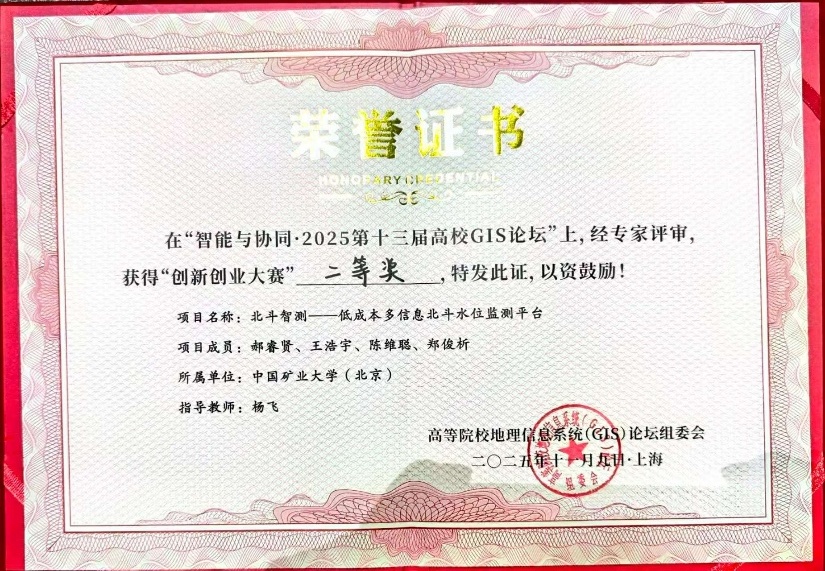
Presenting Our Low-Cost GNSS-IR Tide Gauge at the University GIS Forum 参加高校 GIS 论坛创新创业竞赛:低成本 GNSS-IR 水位计项目荣获二等奖
I traveled to East China Normal University in Shanghai to participate in the 2025 13th University GIS Forum and entered its Innovation and Entrepreneurship Competition. This was my first experience presenting an academic research outcome as an innovation project and defending it from the perspectives of product design, practical application, and future development.
Turning GNSS-IR research into an innovation project
The project centered on a low-cost GNSS-IR tide gauge. It combines GNSS Interferometric Reflectometry with affordable GNSS receivers and a self-developed data-acquisition system to provide continuous, real-time water-level monitoring. The goal is to complement conventional tide-gauge infrastructure with a solution that is more economical and flexible to deploy, particularly at sites where traditional instruments are difficult or expensive to install.
My research has focused on GNSS-IR sea-level and water-level retrieval for several years. Preparing for this competition encouraged me to examine the same work from a different perspective. In addition to algorithm accuracy and scientific novelty, I needed to consider system reliability, product positioning, user needs, deployment costs, application scenarios, and the pathway from a laboratory prototype to an operational monitoring product.
前段时间,我前往上海华东师范大学参加了 2025 年第十三届高校 GIS 论坛,并报名参加了论坛同期举办的创新创业竞赛。这是我第一次将自己的科研成果以创新创业项目的形式进行展示和现场答辩,对我而言是一次十分宝贵的经历。
将 GNSS-IR 研究转化为创新项目
本次参赛项目围绕低成本 GNSS-IR 水位计展开。项目基于 GNSS 干涉反射技术,利用低成本 GNSS 接收机和自主设计的数据采集系统,实现连续、实时的水位监测,希望为传统潮位监测提供一种成本更低、部署更加灵活的补充方案,尤其适用于传统设备安装困难或建设成本较高的观测场景。
近年来,我一直围绕 GNSS-IR 海(水)面高反演开展研究。准备这次比赛的过程,让我有机会从不同于学术论文的角度重新审视自己的工作。除了算法精度和学术创新,我还需要考虑系统可靠性、产品定位、用户需求、部署成本、应用场景,以及如何将实验室原型进一步发展为可以实际运行的监测产品。
Preparing for the on-site defense
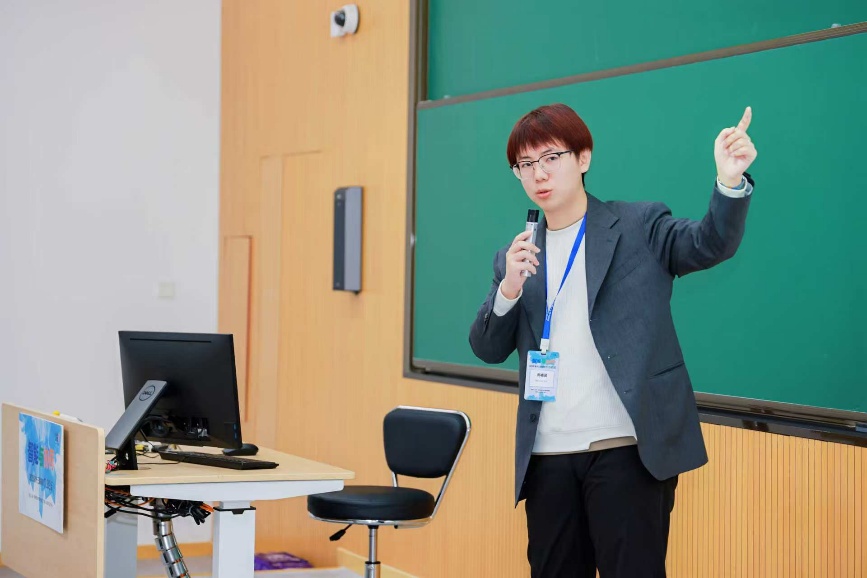
After the preliminary evaluation, the project advanced to the final round, and I was invited to give an on-site presentation and defense. Unlike a conventional academic conference, the competition placed greater emphasis on technological innovation, practical value, market demand, and commercialization potential. My presentation therefore needed to explain not only how GNSS-IR works, but also why the system is useful, who might use it, and how it could be developed further.
This preparation helped me understand that successful technology transfer requires more than a technically sound algorithm. A research outcome must also address a clear problem, fit the operational environment, and offer a realistic advantage over existing solutions. Thinking through these questions gave me a more complete view of the low-cost GNSS-IR system and highlighted several areas for future improvement.
准备现场路演答辩
经过前期项目评审,我顺利进入决赛,并受邀前往现场参加路演答辩。与传统学术会议不同,创新创业竞赛更加关注项目的技术创新性、实际应用价值、市场需求以及未来发展潜力。因此,我不仅需要介绍 GNSS-IR 的技术原理,还需要系统说明项目能够解决什么问题、面向哪些用户,以及未来如何继续完善和推广。
这一准备过程让我更加深刻地认识到,科研成果要实现技术转化,仅有性能良好的算法还不够。一个真正能够落地的系统,还需要面对明确的实际问题,适应具体运行环境,并相较现有方案体现出可操作的优势。围绕这些问题进行思考,让我对低成本 GNSS-IR 水位计有了更加完整的认识,也发现了后续需要继续改进的方向。
Receiving Second Prize
The project ultimately received Second Prize. Although there is still room to improve the system and its presentation, recognition from the judges was encouraging. More importantly, the experience strengthened my ability to explain a technical project to a broader audience and improved my understanding of business models, user requirements, product development, and research commercialization.
During the trip, I also met my high school classmate Wang Jingyang, who is studying computer science at Fudan University. We discussed artificial intelligence, computer technology, research, and our experiences over the past several years. That conversation added an enjoyable personal dimension to the visit and reinforced the value of exchanging ideas across disciplines.
Participating in the University GIS Forum gave me more than a competition result. It helped me see the close relationship between research innovation and practical deployment, and reminded me that interdisciplinary collaboration can play an important role in moving technology forward. I hope to continue improving the low-cost GNSS-IR tide-gauge system and bring it closer to real applications in water-level and environmental monitoring.
项目获得二等奖
最终,项目获得了二等奖。虽然系统和项目展示仍有进一步提升的空间,但能够得到评委老师的认可,我依然感到十分欣慰。更重要的是,这次比赛锻炼了我的项目展示和现场答辩能力,也让我了解到创新创业项目在商业模式、用户需求、产品设计和成果转化方面需要重点考虑的问题。
除了参加比赛,这次上海之行还有一个令人开心的安排。我与高中同学王景阳再次见面交流。他目前正在复旦大学攻读计算机相关专业,我们围绕人工智能、计算机技术以及科研工作进行了深入交流,也分享了彼此近几年的学习和成长经历。跨学科的讨论为这次行程增加了另一层收获。
参加高校 GIS 论坛,不仅让我收获了一项竞赛奖项,也让我进一步体会到科研创新与成果转化之间的联系,并认识到跨学科交流对于推动技术发展的重要意义。未来,我希望继续完善低成本 GNSS-IR 水位计系统,让科研成果真正服务于水位和环境监测的实际应用。